Showing posts with label friendship. Show all posts

Monday, July 31, 2023

Happy Place

Emily Henry's latest, Happy Place, is another book that could be considered a beach read. (The meat of the novel doesn't crop up until nearly the end of the novel.) As such, I started to listen to this one at the beach. It was a great novel to listen to as I was at my happy place.

Harriet's story is told from "real life" and her "happy place," with her happy place being mostly an over-the-top beach "cabin" on the coast in Maine where Harriet and her two college roommates have spent a week every summer. for over 10 years  Over the years, romantic partners are included. The "cabin" is owned by Sabrina's father. His wife #3 (or was it wife #4) thinks it's time that he sells the "cabin" so this is the last summer trip the college roommates will be able to enjoy.

Harriet's happy place becomes a bit less happy (understatement) when she spots her former fiancé, Wyn, at the cabin. What is he doing there? Harriet hasn't told anyone that she and Wyn have broken up. Because this will be the final week at the cabin, the couple decides to pretend that they are still together, as to not ruin the weekend.

The first 90% of the novel is pure fluff, some of it a bit repetitive. And you start to wonder how someone who was able to make it through medical school (Harriet is in a residency in her quest to become a brain surgeon) is so flighty and wishy-washy. For me, the end of the novel, when we really figure out what's going on with Harriet and Wyn, that's where there's some real substance with an important message. A message that gave me satisfaction to hear.

If you like Emily Henry, you should enjoy her latest.


Tuesday, July 4, 2023

Golden Hills

Golden Hills by Jennifer Weiner is a short story that I picked up through Amazon's Prime First Reads program a month or two ago. I'm not a big fan of short stories as they always make me wanting more. Golden Hills was handy to have around the other night when I'd finished one book and messed up my next library loan.

I'm not sure what I was expecting from this short story, but it didn't deliver. Ida Berkowitz is running for Senate in New York. In October, she gets a heads up that a nemesis, Marissa,  from her youth is participating in a press conference related to Ida's past. Could this be trouble? What's up with this October surprise? Marissa is married to a wealthy conservative donor and is being hosted by a conservative commentator. 

Ida and Marissa met at "fat camp" when they were 16-years old. Ida was the daughter of a hardworking single mom who didn't have much to spare and Marissa was the girl who had everything. Yet somehow the two become friends. Weiner makes you wonder what could have possible happened to tear them apart. What's the scandal?

There was too much thrown into this short little story. Politics was unnecessary. Why were the girls at "fat camp"? And why was Ida gay? This was a short story about friendship, worry, and forgiveness. It was pleasant enough to read and it fit the purpose I needed it for.


Thursday, January 12, 2023

A Castle In Brooklyn

More than 24 hours after finishing A Castle in Brooklyn by Shirley Russak Wachtel, I still have such mixed feels about it. A Castle in Brooklyn is one of my Amazon Prime First Read selections. I mean, how could I not pick a book with Brooklyn in the title that is actually set in Brooklyn?

Jacob and Zalman meet as teens while hiding from the Nazis in a farm in Poland. They are found, captured, and en route to a concentration camp when miraculously they escape. Eventually, the two young men make their way to America. Jacob settles in Brooklyn with an aunt and uncle. Zalman, well, Zalman ends up on a farm in Minnesota. The farm of a Jewish farmer in Minnesota. It's unclear to me exactly how he ended up there? And that is my reason for having very mixed feelings. At one point, it seemed as though someone he met in a displaced persons camp recommended he go the farm route. At another point, it states that a cousin of his (in Brooklyn?) suggested he go to Minnesota and work on a farm. (I wish the author would have included a quick chapter explaining how both Jacob and Zalman got to the United States and when.)

That's just one of the inconsistencies that I found in the book. I have probably mentioned before that I'm a nitpicker. And there were so many inconsistencies that started to make me crazy. I felt as though lots of the timeline was off. Some chapters had the years included. Others did not, and in those, the passage of time was often not clear. Other things also didn't make sense. Like why would anyone ask a person who owns rental property and does some apartment development to look for an apartment just so they could see what's out there. 

Other questions I had:

  1. Was there a subway stop a 5-minute walk from a house in Mill Basin?
  2. Was there a restaurant called Wolfie's on Bedford Avenue near Brooklyn College in the 1960s?
  3. Are any of the lots in Mill Basin large enough that in the 1990s there would be woods behind a home?
  4. Leaving Brooklyn, could you drive only an hour south and be in a completely rural area?
  5. Why would there be a reference to Presidents' Day in the 1970s? Weren't we still celebrating Washington's birthday and Lincoln's birthday separately? And if there was Presidents' Day, why would Jacob say that he'd leave any work he needed to do until Monday. Presidents' Day has always been on a Monday.
By including a few of my other questions, I feel like I'd be giving too much of the story away.

Don't get me wrong. This is a lovely story about finding the American dream. It's about a strong friendship between two men. It's about a close friendship between a woman and a man. It's about childhood, parenthood, loss, and moving on. Much of it I was able to relate to because my first husband was a child of Holocaust survivors. Things that might seem odd to someone unfamiliar with survivor mentality might question why two friends might live together once they get to the United States. The arc of the story worked although I wish some of the events had been more flushed out. I also loved seeing some of the references to Brooklyn. Ebinger's black out cake. Barracini assorted chocolates.

Would I recommend this book? I'm not sure. There are so many good books out there. This one was merely okay.
 

Wednesday, April 13, 2022

Exile Music

What a beautiful, multi-faceted novel. To call Jennifer Steil's Exile Music a Holocaust novel doesn't even hint at the richness of the story or the language. It's a Holocaust novel but so much more.

Exile Music is the story of Viennese Orly. She is a young teen when  Hitler moves in. She and her parents must get out of Austria. They flee to Bolivia, the only country that will take them. Her brother had already escaped to Switzerland. Orly is leaving behind everything she knows as well as her best friend, Anneliese. 

In Vienna, Orly's family's lives revolve around music. Her father is a viola player and her mother is an opera singer. Once they are in La Paz, her mother has no more music left in her. Her father continues to play his viola and eventually Orly learns how to play an Indian instrument.

This is a Holocaust novel. Yes. But it's also a novel about Orly's adjustment to Bolivia, both physically (that thin air!) and emotionally. She begins to make friends with all sorts of people. She learns Spanish. At first she must work. Eventually, she returns to school. We learn about the waves of refugees. Those that came during the war, like Orly and her family, as well as those arrived after the war. We learn about the political turmoil in Bolivia as well as the racial intolerance native Indians experienced. There's so much more.

Because I listened to the novel, I wasn't able to highlight lines in the book that could have been written to describe the situation in Ukraine - and in Europe - today. But many times, I thought about timeless authoritarianism and intolerance is. Sadly.

I highly recommend Exile Music.
 

Tuesday, March 8, 2022

The Keeper of Lost Things


I had no preconceptions about Ruth Hogan's The Keeper of Lost Things. I'm not sure if that's why I enjoyed it as much as I did.

The novel tells two distinct stories and of course I was anxious to find out how the two stories would eventually come together. I mean, they'd have to come together at some point, right? 

Anthony Peardew is a keeper of lost things. His losing the first thing, an important thing, a medallion that his fiancee gave him to remember her by, on the day that she died wracked him forever. His approach to moving forward in life was to collect lost objects and writing short stories about them. As he nears the end of his life, though, he worries that he never made an effort to try to get the lost things back to the people who lost them. That effort involves Laura, his assistant. It includes Sunshine, his neighbor. And eventually involves his gardener, Freddie. 

The parallel story is about Boomer, a publisher, and his assistant Eunice. A quirky guy with an infatuated assistant and an interesting family.

I don't want to say anymore and risk spoiling the book for anyone who chooses to read it. But it was a clever story, enjoyable to read, and I would recommend it.

Monday, February 28, 2022

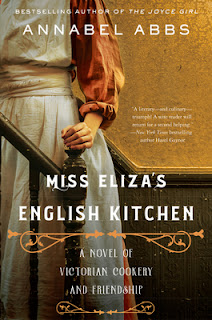
Miss Eliza's English Kitchen

I absolutely devoured Miss Eliza's English Kitchen: A Novel of Victorian Cookery and Friendship by Annabel Abbs. I'd just finished listening to This Tender Land and needed a new audiobook. Fresh on the heels of The Cookbook Club, I stumbled across Miss Eliza's English Kitchen in the library's audio catalog. It sounded interesting. Borrowed the audio and started listening.

The novel is based on the history of Miss Eliza Acton, credited with authoring the first modern day cookbook which included an ingredients list, precise measurements, and precise instructions. Acton considered herself a poet. When he father went bankcrupt and her next volume of poetry was rejected by her publisher and the publisher suggested she write a cookery book, although she was first insulted, she warmed to the idea and spent the next ten years working on her first book, Modern Cookery for Private Families. All this held true in the novel. But in the fictionalized version, Eliza hired Ann as her skullery maid who eventually became her partner in working on the cookbook.

Because of the employer/servant relationship, both Eliza and Ann kept many secrets from each other. It caused them to misunderstand exactly who the other was, so although they did become close, they never really crossed the threshold into what I would consider real friendship.

Eliza held the secrets of her financial situation and her past. While Ann kept secrets about her family life and present circumstances. The reader knows most of the secrets early on... although the one secret that the author revealed much later was one that I predicted incorrectly for a very long time.

The descriptive language used in the novel made my mouth water at times. It made me want to rush back into my kitchen from my walk and experiment with recipes that I could then share with someone... anyone. (I love thinking about food - and eating food - and creating dishes - but at this point in life, the idea of having to prepare something over and over again until perfection is not my idea of a good time. I don't enjoy the act of cooking enough these days. In my younger years, it would have been a dream!)

The audiobook was read by two different narrators, alternating chapters from both Eliza and Ann's perspective. It was entertaining, informative and delectable and I highly recommend.
 

Monday, February 14, 2022

The Cookbook Club


On one of my rare entries into a store this past year, I walked into Barnes & Noble with my daughter while she was attempting to pick up a book. I browsed, picked up The Cookbook Club by Beth Harbison. It must have struck my fancy as I added to my ToBeRead list. After finishing Night and This Tender Land, I was wanting something light to read and this was available from the library.

I had a preconceived notion about what this novel would be like and it was nothing like what I imagined. I expected a novel with a bunch of people in a club where they worked on recipes from a particular cookbook for each month. That part was true. But I also expected the story to somehow be connected to the recipes or the cookbook or  the cookbook author. That wasn't the case at all. 

Beth Harbison clearly has a love of cookbooks. My cookbook collection isn't too shabby either but... when I'm in a need a recipe, I typically head to google and search and print the recipe that most strikes my fancy.

Margo, Aja and Trista are each at a crossroads. Trista has just purchased a bar and has come up with the idea of a cookbook club basically to find like-minded testers for the recipes she hopes to cook and serve at her bar. Margo has just been dumped by her jerk of a husband when she comes across the ad for the cookbook club. Aja is hoping that she can learn how to cook! The three definitely bond over food and this is a wonderful book for foodies. However, the book is more about the women's friendships and the choices that each one makes during a difficult time in her life. Oh... but the food...

If only I wasn't going to be on Weight Watchers for the rest of my life! I'd love a cookbook club! It has given me the idea, though, that if I ever bond with people also following WW, a  WW dinner club might be something fun. Who can make the most delicious healthy food?

One thing that really struck me, though, was what Margo had to go through cooking for her husband. He was truly obsessed with a healthy diet so she wasn't allowed to use butter, real cheese, make fresh pasta, and so on. To think that I think I make things tough on my husband! He can use anything as long as he weighs and measures out what he's using. And he can't use a lot of the foods that I want to limit. I'm nothing like Margo's ex-husband. Although her complaints did give me a window into what my husband might be thinking.

There's also a bit of home improvement stuff in here. As part of Margo's divorce settlement, she's gotten the dilapidated farm house that has been in her husband's  family for years. An old college friend of hers is in need of an escape so in return for free rent, he is doing some renovations for her. I sure hope that future Cookbook Club meetings will be held at Margo's farmhouse.

If you need something light and "a bit cheesy" (pun intended) to read and food is one of your things, you might want to pick this one up.

Monday, January 3, 2022

The Rose Code

Since my New Jersey book club has moved back to zoom meetings for at least the winter, I picked up The Rose Code so I can join them having read the book in January. (In December, their first month back zooming, I joined them but hadn't read whatever they were discussing.)

I've had Kate Quinn's The Alice Network in my list of books to read for quite awhile but hadn't heard of The Rose Code until this book club selected it. It's about women who work together decoding encrypted messages during World War II. I think I might have seen a movie about a group of women doing just that so the historical reality was something in the back of my mind.

Osla, Mab, and Beth first meet when Osla and Mab are billeted in the home of Beth's mother when they are assigned to work at Bletchley Park, at the Government Code & Cypher School. The work is highly secretive and even discussing things amongst each other is considered treasonous. Beth's mother is overbearing and horrible and refers to Beth as "mother's little helper." Beth is also amazing at solving puzzles so Osla and Mab suggest her as an addition to the crew at Bletchley Park. Beth is hired and becomes a top notch decoder. She's always been told that she's good for nothing other than helping her mother and at "BP" she finds her place.

The three women couldn't be more different. Osla is  a society girl, often called a ditzy deb, and in a relationship with the recently deceased Prince Philip prior to his marriage to Queen Elizabeth. I suppose I should say Princess Elizabeth as she had not yet ascended to the throne. Mab has led a hard-scrabbled life and has worked very diligently to elevate her station in life. Beth, the oldest of the three, has lived a very sheltered life. They have different skills, work in different "huts" doing different jobs. The bond together and become extremely close.

Until a betrayal! But who betrayed whom? And how did Beth end up in a sanitarium? The story line jumps back and forth from the war years to the days leading up the Royal Wedding in 1947. I've noticed some reviewers complaining about the jumping back and forth between two timelines, but that's a format that I'm quite comfortable with. In this case, it's what really kept the suspense going.

Many passages in the book were way too technical for me, about the methods and equipment used to decode. It wasn't necessary to understand that. I think the point was that they were doing really difficult work that not everyone is suited to do.

I gave the novel 3 stars on goodreads because it got off to a slow start, not even counting the technical bits that were very often tedious if they ran on too long. But the story was fascinating and the author's note at the end, what characters and parts of the story were highly fictionalized versus actual people and their actual histories. It should make for a good book club discussion.
 

Tuesday, July 6, 2021

Golden Girl

I've read some Elin Hilderbrand but not much. All her books are set on Nantucket - and boy do I want to go to Nantucket right now. But this novel, Golden Girl, was different from the usual as while it was contemporary fiction, it had a big fantasy component.

Golden Girl is a story about divorced mother of 3 young adults, Vivi. Early on in the novel, she's killed in a hit and run accident. Yet Vivi in the great beyond is an active character in the book. She's got "a person" named Martha who was kind of like Clarence in the movie It's A Wonderful Life. I loved the chapters with deceased Vivi and Martha.

The novel is a bit of a mystery. It touches on coming of age issues for both Vivi and her children. Divorce is a theme. Novel writing is a theme. Friendship is a big huge theme. There's some romance. I'm sure there are themes that I'm missing. All the characters are extremely well developed. This was a very pleasant book to read.

I'm ignoring the whole Anne Frank controversy since I read the e-book after the publisher made some changes. I'm not even exactly sure where the changes might have occurred. 

Thursday, July 1, 2021

That Summer

Another book where I hadn't really paid close attention to the blurb before reading the book! While I normally try hard to not include any sort of spoilers, I'm not sure if I can do that in the case of Jennifer Weiner's latest, That Summer

Just two or three books ago, I read Know My Name, memoir of Chanel Miller, the victim in the Brock Turner sexual assault. I wouldn't say that That Summer is the fictionalized version of Know My Name, but it also deals with a sexual assault and the ramifications for the victim and the guilty and the loved ones of the victim. I think having read Know My Name first, I had a different appreciation for That Summer than I might have otherwise. Both references directly deal with the #metoo movement which brings up certain memories of my own.

Because timing is everything, it made me absorb the news that Bill Cosby, found guilty of sexual assault, had his sentence vacated on the day I finished reading That Summer. My first thought was to wonder what horrible impact this must be having on the victims. They must all be wondering why they bothered coming forward. Once again, for  whatever the reasons, justice was not served.

In this novel, one of the main characters, Daisy, lost her best friend to cancer and feels the hole in her life left behind. Each time she missed Hannah, I found myself missing my cousin, my best friend, who passed away 5 years ago. The heartache is still there.

That Summer is about friendships, secrets, surviving our pasts, and forging our futures.
 

Saturday, December 26, 2020

Eleanor Oliphant is Completely Fine


Eleanor Oliphant is completely fine. Or at least she says she is. And she's sort of convinced herself that she really is fine. And that's the way Eleanor's story in Eleanor Oliphant is completely fine by Gail Honeyman begins.

(Kind of like my mom in the last years of her life. She was always "Fine," whenever you asked how she was. In fact, everyone was fine and everything was fine. Was she trying to convince herself or just convince me?)

Eleanor is a 30-something living a solitary life in Scotland, working as an accounts clerk at a graphic design firm. She goes to work, where she spends much of each day judging her co-workers. She spends her lunch hour at the same spot eating the same thing every day, while doing the crossword puzzle. And then she goes home, alone, to eat (pesto during the week, pizza on Fridays), drink vodka, read, and sleep. A really sad existence. No friends. Unless she goes to her corner convenience store over the weekend, she can go from leaving work on Friday to returning to work on Monday without speaking to another soul.

At 30, Eleanor has zero social skills, an outdated way of speaking, and an odd sense of dress that she thinks should make her invisible, but rather makes her stand out as an oddball instead. She spots a musician with whom she "falls in love" and dreams of a normal future on the arms of this rock star.

In the process of trying to recreate herself to be the perfect mate to the musician, Eleanor is removed from her routines. While out of routine, she and a co-worker witness a man collapsing on the street and get him to the hospital. She is drawn into the lives of these two men and this is what really starts Eleanor's whole world changing.

I found parts of the novel extremely predictable, but Honeyman's descriptive language and development of the characters were a joy. Even when Eleanor rediscovers some not so joyful parts of her past, we are rooting for her. I'm sure I'm not alone in being able to connect with Eleanor on some levels. I don't want to say that this is a feel good read, because it truly isn't. But I did really enjoy reading it.

Friday, December 1, 2017

My Brilliant Friend - in translation

I chose to read My Brilliant Friend written by Elena Ferrante and translated by Ann Goldstein when I wasn't quite ready for the heft and heaviness of Les Miserables, the Books and Beer (two month) title for January's discussion. I saw that a friend had read it and enjoyed it, it was available from the library when I wanted it so off I went.

I found the book extremely difficult to get into. There were lots of characters and each went by several different names. The language was really rough which made me wonder about the translator's ability. It probably took me until about halfway thru the book before I got into a groove. I knew the characters well enough and I realized that the language was rough and sparse for a reason.

My Brilliant Friend tells the story of two girls growing up in a poor suburb of Naples in the 1950s. The narrator is simply smart but her friend, Lina, is brilliant in every way possible. The relationship is a complex one. One in which they pull together ... until some competition ... in the head of one or both of them (most often in the head of Greco, the narrator) pulls them sort of apart.

Lina is the daughter of the shoemaker. Greco is the daughter of a porter at the government building. After elementary school, Greco has the luxury of continuing her education while Lina goes to work in the family business. As Greco continues her education, their paths grow further and further apart. But still they are connected.

I have no doubt that the picture the author paints of the area and time in which they grew up (and which the author most likely grew up) is pretty accurate. Lots of feuds, lots of violence, lots of grudges. The guys with the cars held the status. The kids with the education were considered outsiders. The language was rich enough, however, that I was able to visualize a lot of what I was reading about. Perhaps because I've spent a little bit of time in that part of Italy? I'm not sure.

The book ends very suddenly, with a very interesting cliffhanger. I will definitely add this series to the list of books to go to when I'm not on a self-imposed book club sort of deadline. The book begins in the present and ends in the late 50s or early 60s. So of course I'm very curious about how the "girls" get from there... to here. And I'm curious about the cliffhanger.

I would only really recommend this to a reader who is willing to give time to a book and not drop it when it first doesn't grab you. The chapters are short which made getting to the point where I really wanted to read more a whole lot easier.