Showing posts sorted by relevance for query underground. Sort by date Show all posts

Saturday, July 18, 2020

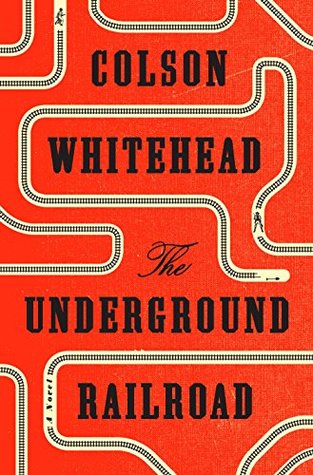
The Underground Railroad

I guess I hadn't read any of the reviews about Colson Whitehead's Pulitzer Prize winning novel, The Underground Railroad. I had no idea what to expect, but when I noticed I had the book on my shelf, I decided it was probably an important book to read now.

The Underground Railroad isn't the usual historical fiction depiction of a horrendous time in our country's history. In this novel, the Underground Railroad is an actual railroad, with platforms, tracks and different sorts of passenger accommodations. I found that off-putting. Each and every time Cora, the runaway slave from Georgia, was at a station, I'd kind of scratch my head. I think I wish I'd read the blurb before starting the book so I would have known at least this!

Whitehead goes further to imagine different realities for the  runaway slave as she makes her way north. In South Carolina, North Carolina, Tennessee, and finally Indiana. As soon as I turned the last page, I started researching whether some of the things Whitehead includes were realities. Much of the "history" in this novel is speculative. What if...

I found his language mostly brilliant, but the story didn't flow in one smooth path. He'd interrupt the story while jumping back in time to fill in backstory for one of the secondary characters. Once I realized that this was what he was doing, I was okay with it and it didn't disrupt my reading process terribly. But until I did, I found it distracting. The book took me a long time to finish, probably because I was reading from a paper-and-ink book, so I'd lose the plot a bit and have to turn back and reread.

It might sound as though I didn't really like this book. And I'm not sure that I did. But I did like the way Cora's story made me think. It made me think about what I already know about the Underground Railroad. It made me think more about what the journey north might have been like. It made me think more about what Cora's future might have been like. And it makes me think of the progress, or lack thereof, towards racial equality that our country has undergone. The details of this novel might not stick with me long, but the thinking that it pushed to the front of my brain will stick with me for a long time to come.

Toward the end of the novel, this quote really struck a chord.
"And America, too, is a delusion, the grandest one of all. The white race believes - believes with all its heart - that it is their right to take the land. To kill Indians. Make war. Enslave their brothers. This nation shouldn't exist, if there is any justice in the world, for its foundations are murder, theft, and cruelty. Yet here we are."
Yes, here we are. Whitehead started this novel in 2000, worked on it for 16 years, published in 2016. Four years later, in the summer of 2020, that quote is more timely than ever.

Thursday, March 14, 2019

The President is Missing

As absorbed as I can be by politics, political thrillers don't thrill me. I've read enough James Patterson to know that his style is not my style. But... when I thought The President is Missing was going to be our April community book club title and it was available in the library, I picked it up to read. It's now our May selection, I probably won't be able to make it to the meeting, but I'd started the book so I finished the book.

It's hard for me to review a book in a genre that I don't like because lots of what I think is colored by the fact that I'm already predisposed to not like it. It took me more than half the book to get into the story and then I finished the second half of the book in a couple of days. Because I wanted to be finished. And I wanted to see how this duo of thriller writer and former president wrapped things up.

The novel takes place over a few short days. After a cyber-terror threat to the USA, the president goes underground with the hacker who worked on the virus to avoid the internet - and everything associated with it (is in everything - food supply, power grid, water supply, commerce, life insurance, everything) going down.

There's a lot of political talk, second thinking presidential decisions. There is one flashback to when the president met his wife. That added a bit of personal touch to the novel. I think a little bit more of that was needed. Lots of the action takes place in a communications room where techno-geeks from all over the world try to crack the code of the virus in order to destroy it. A mystery is that there is at least one treasonous party in the president's inner circle. But who is it?

I had a few general problems with the novel.

  • There really was no character development. The characters (good guys, bad guys, in between) were introduced but we never really got to know what makes them tick. There's a lot of "tell" but not a whole lot of "show" when it comes to characters. 
  • No one really seemed to care that the president was "missing." Was he missing? We knew exactly where he was. And even though the vice president didn't know where he was, she was in communication with him.
  • The conclusion of the book reads like a campaign speech.
If I was going to be at the book club discussion, I'd have the following questions:
  • When was this book written? Culturally, how current is it supposed to be?
  • Is this Clinton's way of rewriting some of his own history?
  • Was there a political motivation behind the writing of the book?
  • Did readers find it politically motivated, no matter what the intention of the authors was.
I'm much more curious about the authors' purpose, the authors' styles than about discussing the particulars of the novel.

I am hard pressed to say whether or not I'd recommend this, because again, it's just not my type of story.


Wednesday, March 31, 2021

The Nickel Boys


I don't even know where to begin with writing about Colson Whitehead's The Nickel Boys. What a powerful read.

I read Whitehead's previous novel, The Underground Railroad, back in July of this year. I enjoyed that one, although am still not sure how I feel about some of the fantastical aspects of the novel.

The Nickel Boys is different. It's based on the true story of The Dozier School for Boys, a boys' reform school in northern Florida that was in existence for over 100 years. The two things that struck me most about  this book were my familiarity with the discovery for unmarked graves of students on school property in 2011, the year after I moved to Florida. The other thing that brought me to pause was following the Derek Chauvin murder trial, for the killing of George Floyd last May, at the same time.

Elwood Curtis lived with his grandmother in Tallahassee, Florida in the early 1960s. He was an inquisitive boy and tried to stick to the straight and narrow. He received an album of Martin Luther King Jr.'s speeches which became a treasured possession. In high school, he got involved with the Civil Rights movement. He develops a relationship with one of his teachers who makes it possible for Elwood to attend a black college on the outskirts of Tallahassee while  he's still in his senior year of high school. Because the college is  on the outskirts of  town, Elwood needs to hitchhike to get to the college. He gets picked up by a Packard which turns out to be a stolen car. As a punishment for "his crime," Elwood is sent to The Nickel Academy.

The Nickel Academy is open to both black and white boys, but it is very much segregated. We are led to believe that the experiences of the white boys versus that of the black boys is very different. Elwood, as a black "student," gets punished early on and winds up in the hospital. After that, he's a bit more careful. Until he decides that he needs to take a stand against the injustices against others that he observes during his time at the reform school. 

Living in Florida has been eye opening to me. I was raised in NYC and while I'm sure everyone was not treated equally or fairly, the racism wasn't as blatant as it is in the south. In 2011 when the story of The Dozier School broke, I had a hard time something so horrible could be happening "in this day and age" so close to where I was living. One of the characters in the novel, Millie, was raised in NYC and she has a hard time coming to terms with what "Elwood" has experienced.

This week, though, listening to the Derek Chauvin murder trial, I can't help but wonder about the lack of progress we, as a nation, have made over the past 60 years in terms of civil rights. We haven't come far at all. We have a very long way to go.

I would highly recommend  this griping, spare, raw novel.

Saturday, June 24, 2017

The Lilac Girls

Another book that was suggested to my community book club which wasn't selected was Lilac Girls by Martha Hall Kelly. Similar to LaRose, it's another book that begs to be discussed but for many in the book club, I think it would be too much of "the same." We probably haven't read a Holocaust book in a long while, and this book, told from three different perspectives, differs from many other books we've read in the past. But this book would not have been a good fit for our book club at this time.

Lilac Girls tells its Holocaust tale from the perspectives of New York City socialite, Caroline, Polish political prisoner, Kasia, and  German doctor, Herta, a loyal Nazi whose dedication to the party quickly overtakes the Hippocratic Oath. Lilac Girls is based on the true story of  women whose lives were somehow connected thru experiences at the only women's concentration camp, Ravensbruck, during World War II.

Kasia's story, as a prisoner, was most grizzly and probably the type of story that readers to Holocaust novels are most familiar with. Kasia had become part of a teen underground in Lublin, Poland, in the early years of the war and when she gets arrested, her sister and mother get caught up and sent to Ravensbruck along with her.

Herta's story was less familiar and because of that much more disturbing. Herta was upset by Hitler's forbidding women from being surgeons. She applies for a job at Ravensbruck, which she understands to be a "reeducation camp for women, 90 km north of Berlin, near the resort town of Furstenberg on Lake Schwedt." On her first day, she is instructed to lethally inject an elderly prisoner. Her initial reaction was to flee. But her desire to be a surgeon quickly wins over, she stays and transforms into a monstrous part of the Nazi party machine.

I'd read about "medical experimentation" on Jewish concentration camp victims. This novel went into much more detail regarding what was involved with the particular non-Jewish group of women prisoners at Ravensbruck. The experimentation subjects became known as the Ravensbruck Rabbits. The novel says that's due to the women "hopping around the camp" after surgery and because they were the camp guinea pigs. In my mind, it was solely the latter.

The Ravensbruck Rabbits was an actual group of women. Herta Oberheuser was an actual doctor. And Caroline Ferriday was an actual socialite who wanted to make sure that the story of the Ravensbruck Rabbits was told.

Herta's story begs one to wonder just how quickly and easily the transformation from one who wants to save lives to one who is okay with ending innocent lives can happen. No matter how many books I read, I will never understand.

Caroline's story had a component of a "forbidden love" story, full of the soap opera miscommunications and missed opportunities. And as I was reading, I wondered how her story was going to intersect the stories of Kasia and Herta. Caroline's story also brought me back to wondering about what my young mother knew about what was going on in Europe during the 1940s.

I can't say I enjoyed reading this book. Impossible to enjoy. And thinking about what I was reading contributed to one night of very poor sleep. However, it certainly told a different story from two points of view that I was less familiar with. It is because of the different point of view that I am able to recommend Lilac Girls with reservations to anyone who is a frequent reader of Holocaust historical fiction.

Monday, June 26, 2017

Hum If You Don't Know the Words - a book to look for

Hum If You Don't Know the Words, a debut novel by Bianca Marais is the second goodreads giveaway I won recently. Here's the description that motivated me to enter.

Perfect for readers of The Secret Life of Bees and The Help, a perceptive and searing look at Apartheid-era South Africa, told through one unique family brought together by tragedy.
Life under Apartheid has created a secure future for Robin Conrad, a nine-year-old white girl living with her parents in 1970s Johannesburg. In the same nation but worlds apart, Beauty Mbali, a Xhosa woman in a rural village in the Bantu homeland of the Transkei, struggles to raise her children alone after her husband's death. Both lives have been built upon the division of race, and their meeting should never have occurred . . . until the Soweto Uprising, in which a protest by black students ignites racial conflict, alters the fault lines on which their society is built, and shatters their worlds when Robin s parents are left dead and Beauty s daughter goes missing. 


After Robin is sent to live with her loving but irresponsible aunt, Beauty is hired to care for Robin while continuing the search for her daughter. In Beauty, Robin finds the security and family that she craves, and the two forge an inextricable bond through their deep personal losses. But Robin knows that if Beauty finds her daughter, Robin could lose her new caretaker forever, so she makes a desperate decision with devastating consequences. Her quest to make amends and find redemption is a journey of self-discovery in which she learns the harsh truths of the society that once promised her protection. 


Told through Beauty and Robin's alternating perspectives, the interwoven narratives create a rich and complex tapestry of the emotions and tensions at the heart of Apartheid-era South Africa. Hum if You Don t Know the Words is a beautifully rendered look at loss, racism, and the creation of family.


Here is my review from goodreads.

"When was the last time I picked up a 400+ page book on a Saturday afternoon and didn't go to bed until I'd finished reading? The publication date for Hum If You Don't Know the Words isn't until the middle of next month but I believe at some point in the not too distant future this book is going to appear on so many "best book club titles" lists. It's a multi-layered book with much to talk about. But unlike some other books I've read recently that begged to be talked about, this book can be read alone. Without added benefit of a book club discussion. Just be prepared to do a lot of thinking about what you're reading while you're reading it - and after you've finished the book. I'm going to be thinking about what I read for a long time to come.


I was able to read Hum If You Don't Know the Words by Bianca Marais prior to publication thanks to an ARC from Penguin Random House and G.P. Putnam's Sons. What a wonderful book. So thrilled that I will be able to say I read it before it becomes one of this year's most talked about books.

I thought I knew a lot about apartheid and I thought I was able to adequately imagine what life must have been like in South Africa in the late 1970s. I was a college student, witnessed protests on the streets of Philadelphia against apartheid. Had been an overseas student at Tel Aviv University side-by-side with many students from South Africa. I knew all those students had household servants. That's what I thought was different between "us" and "them." I never imagined that those household servants weren't allowed to use the bathrooms - or even the dishes and silverware - of the family that they worked for. On an intellectual level, I knew how horrible apartheid was. I knew it was on par with the United States South in the days of Jim Crow. But I simply didn't know on a real level what this translated to in everyday life. This book gave me a window into that world. Into South Africa of the 1970s, at a time when real change was on the verge of taking place.

Why is is that I never thought to ask those South African students in Tel Aviv about their Jewish lives back home, since I presume many of those students were Jewish? One of Robin's closest friends is a Jewish boy who is forced to be home-schooled because of anti-Semitic bullying at the school he had attended. Were my former fellow students bullied like that? And how is it that I didn't realize that these same fellow students didn't grow up watching television the way we did in the United States? Once a week, a group of us would go down to the lounge in our "F" dorm and watch The Muppet Show. Television had only come to South Africa a few years prior. Was being able to watch something like The Muppets a big, huge deal to those who had only started watching television? How did I not know?


When I think about the Civil Rights era in the United States, I think of something that happened before I was born (even if that's not quite true). But this story took place at a time when I (thought I) was aware of what was going on in the world around me. We boycotted companies that did business in South Africa. We protested. We signed petitions. My contemporaries marched. This was a horrible period of history in my lifetime. I likened the stories about the activists in this novel with stories I'm familiar with about our Underground Railroad.
 
Hum If You Don't Know the Words is a complex, rich novel. It's a story of apartheid. It's also a coming of age story. It's a story of creating family from the people you choose rather than those you are born to. It's a story about motherhood. And finally it's a story about love. It's a story of hope in a world where violence and hatred have taken a firm hold.

I try not to read reviews of books prior to picking up a book so it wasn't until after I'd finished reading that I explored some of the reviews on goodreads. Overwhelmingly, readers loved the book. A few people complained about the telling of Robin's story. She's telling the story of the year she turned 10 from the perspective of an older person. Her narration alternates between sounding like it's being told by a child and being told by adult Robin. I had no problem with that. Or the ending of the book? That it was just too neat and pretty (Did you really think for a moment that I am going to tell you how it ends?) The book wasn't perfect, but none of those issues detracted one moment from my full immersion and enjoyment of the book.

Bianca Marais' language is delightful. Her storytelling is seamless. I look forward to reading more of what she chooses to write. I will recommend this book to anyone, the highest compliment I can give to an author."