Showing posts with label WWII. Show all posts

Wednesday, August 30, 2023

The Postcard

The Postcard by Anne Berest came highly recommended by a friend who knows a lot about me. She didn't steer me wrong. What a book. It's a fictionalized version of the author's family history.

In 2003, Anne's mother receives an anonymous postcard, an old postcard, with the names of her relatives that had been killed during the Holocaust. This set Anne's mother, Lelia, on a quest to learn more about the history of her family. Years later, in 2018, Anne, herself becomes obsessed with the postcard. Who were these people? Who might have sent the postcard and why?

The autobiographical novel is told as Anne's mother shares some of the stories with her daughter and then some of the research that Anne is doing on her own. There's a bit of antisemitism in Anne's daughter's classroom which Lelia believes Anne needs to take care of immediately.

The Rabinovitch family went from Moscow to Latvia to Palestine and eventually thought they'd found the perfect home in Paris when the world gears up for World War II. Anne - and her mother - feel very disconnected from their family history.

I'm disappointed with myself that I didn't highlight the passage that brought the most meaning of the book to me.I hope this won't be considered a spoiler. Anne never really feels quite Jewish and eventually she realizes that day in and day out, she's a descendant of survivors. I think I've mentioned that I was married to the child of Holocaust survivors so reading about Anne's lightbulb moment and questions I often wondered about my former husband's connection to Judaism, things clicked for me, too, in a very impactful way.

I've recommended this to others and so far, those who have read it were glad they had.

Monday, July 31, 2023

The Italian Ballerina


I'm still trying to read all the books I can that are set in places in Italy that I might be visiting. A good part of The Italian Ballerina by Kristy Cambron is set in Rome. What was especially nice is that some of the history that was covered in this novel was something I'd first learned about in Eternal by Lisa Scottoline.

Before I tell you a little bit about the story, I must say what I didn't like about this novel. It's told from the point-of-view of several of the characters. The timelines jump around, even within chapters! Once I figured out that this time jumping was similar from chapter to chapter, it became a lot confusing. But I'm really not sure why they author decided to write the book this exact way.

Shortly after the death of Dr. Court Coleman, as his family is trying to pick up the pieces, the family is contacted by an Italian woman who claims to have a precious heirloom of Dr. Coleman. His family knew that he had been in Italy during WWII, but what was his connection to this mysterious woman.

Eventually, granddaughter, Del, decides to travel to Italy to unravel this mystery. She (and the reader) learn about what her grandfather experienced during WWII during the time when Jews were being most persecuted in Italy. Court is part of a scheme set in motion by a doctor and a prima ballerina from London to do what they can to protect as many Jews as they can. (The connection to Eternal: Syndrome K, a made up highly contagious disease that a doctor in a Roman hospital creates in order to keep the Nazis out of his hospital wards, the wards where he attempts to protect the Jews.)

In Italy, Del stays with the mystery woman, Italian ballerina, Calla, and her grandson, Matt. Slowly, Del learns Calla's story and how her grandfather's story intersected with hers.

I believe the only factual information in this novel was about Syndrome K. But the story does prove that even during a horrific time in history, there were good people going above and beyond to do good deeds.

In fact, the real life doctor, Dr. Borromeo was recognized posthumously by Yad Vashem as a Righteous Among the Nations, an honor used to describe non-Jews who risked their lives to save Jews during the Holocaust. In addition, the hospital, the Fatebenefratelli Hospital, received an honor in 2016 from the International Raoul Wallenberg Foundation, an American organization dedicated to remembering and honoring acts of heroism during the Holocaust. 

Off to google if the hospital is something I might want to see while in Rome. (It's not too far from where we are staying. Perhaps it will be somehow included in our walking tour of the Jewish ghetto.)


Tuesday, June 27, 2023

Eternal

After struggling with Loyalty by Lisa Scottoline, I wasn't sure how much I'd enjoy Eternal. I loved Eternal. Reading Loyalty, I probably learned more about Sicily and the Mafia than I learned about Rome during WWII, which is mostly what Eternal is about. 

My first inclination would be that it helped that I was listening to Eternal and I could really enjoy the dialog (the actors that read the novel were wonderful). But the dialogue in Eternal was so much richer than the dialogue in Loyalty. The characters were better developed. I really can't say enough good things about it. 

It most definitely did help that my husband was on board to listen to this 19 hour audiobook while on a recent 1,300-mile road trip. He might have enjoyed this one as much as I did, which isn't often the case. Listening to this story was the perfect preparation for our upcoming trip to Italy.

The first stop on our trip will be to Rome. When we were last in Rome, in 2010, we were at the Trevi Fountain. Sort of. We couldn't get near the Trevi Fountain. I said, "That's okay. I don't care if I'm not close enough to toss a coin in. I don't plan to come back to Rome anyway." Here it is, 13 years later, and we're heading back to Rome. The focus of the Rome stay is on Jewish Rome. We're staying just across the river from Trastevere where much of the action takes place. We're going on a walking tour of the Jewish ghetto where a lot of Eternal took place. We're also going on a Jewish tour of the Vatican (assuming I can actually get tickets to the Vatican - who knew that would be so difficult!) and a small but important part of Eternal took place at the Vatican. Now I can't wait to see all that we listened about.

I'm just going to copy the synopsis of the novel directly from Goodreads.

Elisabetta, Marco, and Sandro grow up as the best of friends despite their differences. Elisabetta is a feisty beauty who dreams of becoming a novelist; Marco the brash and athletic son in a family of professional cyclists; and Sandro a Jewish mathematics prodigy, kind-hearted and thoughtful, the son of a lawyer and a doctor. Their friendship blossoms to love, with both Sandro and Marco hoping to win Elisabetta's heart. But in the autumn of 1937, all of that begins to change as Mussolini asserts his power, aligning Italy's Fascists with Hitler's Nazis and altering the very laws that govern Rome. In time, everything that the three hold dear--their families, their homes, and their connection to one another--is tested in ways they never could have imagined.

As anti-Semitism takes legal root and World War II erupts, the threesome realizes that Mussolini was only the beginning. The Nazis invade Rome, and with their occupation come new atrocities against the city's Jews, culminating in a final, horrific betrayal. Against this backdrop, the intertwined fates of Elisabetta, Marco, Sandro, and their families will be decided, in a heartbreaking story of both the best and the worst that the world has to offer.

Unfolding over decades, Eternal is a tale of loyalty and loss, family and food, love and war--all set in one of the world's most beautiful cities at its darkest moment.

I really can't say enough good things about this novel. If you're interested about Rome during WWII and the life of Jews in Rome in the years leading up to and during WWII, I strongly recommend this.

Monday, April 3, 2023

The Bookseller of Dachau


As is our tradition, my Jewish book club will be discussing a Holocaust novel in conjunction with the synagogue's observance of Yom HaShoah, Holocaust Remembrance Day. This year's selection is The Bookseller of Dachau by Shari J. Ryan.

Part typical Holocaust novel, part romance story, The Bookseller of Dachau is a novel full of hope. In fact, one of the characters whom we don't get to know well is named Runa which secret. Matilda is always looking for a sign that will give her hope, always associated with her secret.

The novel is told in two storylines. One is the story of Matilda and Hans during WWII in Dachau. The other is a contemporary story about American Grace and German Archie who meet in Dachau when Grace inherits property in Dachau. I especially loved the explanation that those who live in present-day Dachau as to why they are still there.

As with other books about the Holocaust that I've read recently, I can't help but make connections to what happened then to what is happening in our country now. That frightens me. I don't want to allow the hopefulness of this novel to get my guard down. I'm also amazed in one way, not surprised at all in another, that while atrocities were going on in the concentration camp at Dachau, "Life is moving about as if nothing out of the ordinary is happening." Yikes!

This should be a good discussion.

Monday, December 5, 2022

The Paris Library


Janet Skeslien Charles' historical fiction, The Paris Library, is told is dual timelines. What I'd consider the main story is set in France during World War II. The other story is about young Lily, living in rural Montana, yearning to be a part of the bigger world. She's intrigued by her very private French next door neighbor and wants to learn more about her story.

Oriel had always loved books and longed to be a librarian for as long as she could remember. In the late 1930s, she's lucky enough to get a position in the American Library in Paris. Readers - and especially library lovers - will love this aspect of the novel. I know that part of the story.

What made this novel most compelling is that several of the characters were actual people who managed to keep the library open during the war. The library was an important gathering place and a place where friendships were developed. The head librarian created "The Soldier's Service" to provide serviceman with books to read during the war. It reminded me of the Kentucky Packhorse Library but during a war.

The relationships in the book developed in a natural, authentic way, ebbing and flowing the way relationships do in real life. Sometimes we recognize how much we can count on our friends and what it takes us to be good friends to them. Other times, they disappoint us and we, purposely or inadvertently, disappoint them.

The novel is about "r" esistance during the way. And yes, the fact that there's a lowercase "r" is important. This is not a story about The Resistance. I'd highly recommend it to those who recognize the importance of libraries and books.

Tuesday, November 8, 2022

The Alice Network

I think what I found most fascinating about The Alice Network was that it seamlessly blends stories about World War I and World War II. The story is told in two different timelines, from two different character's points-of-view.

Eve's story is told mostly about her experience as a female spy in occupied France during World War I. Charlie's story takes place shortly after the end of World War II. Charlie is a young, unwed, pregnant woman in Europe with her mother so she can get an abortion, something which is illegal in the United States at that time. She decides almost on a whim to search for her French cousin, Rose, who went missing towards the end of World War II. After fighting with her mother, she heads off to London in search of a woman who might have some connection to Rose. That woman is Eve. Most of the Charlie chapters are about Charlie, Eve, and Eve's Scottish driver, Finn, driving around France looking for any clues about where Rose might be.

As I was reading, I realized that most of the novel was based on historical events, but it wasn't until I was done reading the story and was reading the notes afterwards that I realized how much of the story was very closely based to actual events. The Alice Network is a book that pulled me right in and kept me interested until the end. I look forward to my book club discussion this afternoon.
 

Monday, August 29, 2022

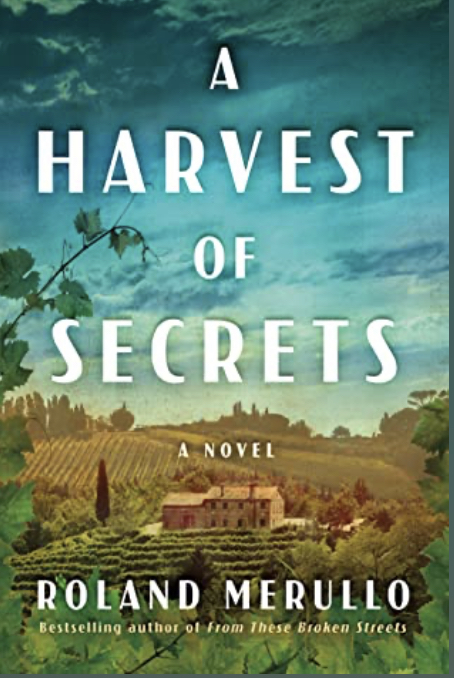
A Harvest of Secrets

Another waiting period for library books to become available so I once again I picked up my Amazon Prime First Reads. This one, A Harvest of Secrets by Roland Merullo, I believe was my August 2022 choice.

A Harvest of Secrets is another World War II novel. This one was set in Italy. Each book I read about the war experience in Italy gives me a totally different aspect of what the war must have been like. This novel focuses on the partisan network in Italy in a more in-depth way.

The main characters of the story are Vittoria, daughter of a prosperous vineyard owner, and Carlo, the vineyard keeper. Besides the usual problems when social classes fall in love, Vittoria and Carlo are separated during the war. She's at home with her father and brother keeping the wine business and farm going and Carlo has been conscripted and is off fighting the war. Old Paulo, the foreman of the vineyard is another key character, holding secrets from the past.

I spent a lot of time thinking as I was reading. How do you figure out (in real life) who is on what side? How do you trust anyone? And I wondered how those with different views on the war maintained their relationships.

I was on the fence over whether I should round my 3.5-star rating in my head to 3-stars or 4- on Goodreads and ultimately went with rounding up. It was a well-written, engaging story that made me think. A lot.

I'm going to leave you with the two quotes that struck me the most.

Mussolini will make us great again. Il Duce is creating another Roman Empire. A true man, he'll never let Italy be disrespected on the world stage!

- - - - - - - - - - - - - - -  

"Your problem," Antonio went on, the words flowing out of him now, as if a dam had broken, "is that you want to be pure. A pure man. In war you can't remain pure and you can't remain neutral. You're fighting with us now. You've made your choice." 


Monday, August 1, 2022

The Good Left Undone

I always enjoy a good Adriana Trigiani novel so was excited when I learned about her latest, The Good Left Undone, and requested it from the library pre-publication. I was very happy to have it become available towards the end of my New York vacation.

The Good Left Undone has so many interesting themes told in two alternating timelines. We read about Domenica's story in the past, and then we read about Matelda and her granddaughter, Anina, in the present. Domenica's storyline has themes of women's opportunities, reproductive health care and several different World War II themes. Both timelines were set in Italy, but the timeline from the past included part of the story set in Scotland. I learned about the Italian population and their horrible treatment during the war in Scotland. The present storyline had an end-of-life theme as well as themes related to motherhood and women's choices. Both stories dealt with family legacy.

Domenica's father was a highly respected jewel cutter. The family business continues through to the current time.

As always, Trigiani novels have a good feel for life in Italy over the years as well as the dynamics as the Italian family.

There was one hanging thread regarding Matelda's brother. Reference was made to an estrangement between the two, but it was glossed over. Why bother including that little bit without resolving that part of the story.

Even with that, I'd highly recommend this for all fans of Adriana Trigiani.


Saturday, April 2, 2022

The Seven Year Dress

It's April again. This year, Yom HaShoah, Holocaust Remembrance Day, is on April 27th. The synagogue book club reads their one Holocaust novel in conjunction with Yom HaShoah observance. I'd gotten a list of lots of novels and memoirs. Restricting myself to novels, I selected a few that were considered more uplifting than completely distressing and this was high on the list. The group voted and selected The Seven Year Dress by Paulette Mahurin.

I'm curious to learn if others in the group felt this was uplifting. The Tattooist of Auschwitz was a Holocaust novel that I considered uplifting. This one, not so much so.

What would have really made this book would have been if Mahurin had given some information about how much of this story was based on the actual experience of someone she knows or why she was inspired to write this novel. I'll do some research before the book club meeting, but it would have been nice to have that information as part of the experience of reading the novel.

Helen's story of the 7 years that she was either in hiding or as a prisoner in a concentration camp was slightly different than others that I've read. So there should be something to discuss her. But the novel didn't live up to the slight hype that it received. I hope the group won't be angry at me for suggesting this one. They weren't thrilled about Color Me In. Thinking someone else should make the book recommendations for awhile.


Sunday, March 27, 2022

The Kitchen Front

Jennifer Ryan's The Kitchen Front was a bit of "light" World War II reading. Light WWII reading? Yes. The Kitchen Front is about a cooking competition held by the BBC is England. The chosen winner will co-host a radio broadcast called "The Kitchen Front" where tips are given about how to provide meals to family using what's available through rationing and via other means (hunting, bartering, foraging, and, yes, picking up items on the black market).

Four women are chosen by the current male radio host to participate in the competition. Four very different women. Audrey is the widow with 3 children, struggling to keep the roof over their heads. She's become a home baker to earn money to support her family. Lady Gwendoline is Audrey's upper class sister who lords her position and wealth over everyone, most especially Audrey. She's a home economist, to do her part for the war effort, going around instructing women on how to create meals keeping in mind the rations and what is currently available. Nell, under the direction of Mrs. Quince, is a kitchen maid in Lady Gwendoline's home. Mrs. Quince is known to be one of the best cooks in the county and possibly all of England. Mrs. Quince is getting older and Nell is the one doing the cooking. Nell was way too shy to compete on her own. Finally, there was Zelda. Zelda had been a chef at a fancy London hotel prior to the war. At the time of the competition, she's working as a chef at a factory as her part of war service. She hopes that by winning the competition, she will be viewed as head chef material and will be able to go back to London and get a position as a head chef.

The competition has three rounds: starter, main and dessert. Each women interpreted the challenge of cooking within the guidelines of the rations differently. Dishes went from simply throwing together ingredients to creating simple, delicious food from what was available, to trying to create elegant meals. I enjoyed the food descriptions and how each contestant decided what she would make for each found.

A few other observations. It was interesting to read this novel after reading The Secret History of Home Economics. Had I read this book first, I don't think I would have given as much thought to Gwendoline's role as a home economist. It reinforced things I'd thought about while reading the Secret History. I also made frequent connections to both The Cook Book Club and Miss Eliza's English Kitchen

My other observation came from reading about a war in Europe while there is presently a war raging in Europe (limited to Ukraine, for now). In one scene, Zelda teaches Audrey's sons to identify airplanes flying overhead so they know whether to be afraid or not. The very next night, on television, I saw a man being interviewed in Kyiv who was talking about things that had changed since the war first began. He talked about how now, a month into the war, he and his children are able to identify what is flying overhead by both sight and by sound, so they know whether they need to be really frightened or simply unsettled. Another war connection was the POW character, Paolo, who says he'd rather be a POW in a place where he's treated kindly than a soldier. He was meant to be working in his family's restaurant, not shooting people. I've  heard similar things about Russia soldiers who have surrendered in Ukraine. How are there so many similarities between then and now? Hasn't society learned anything? Or... or... won't get into what I think about the situation right here, right now.

Learning more about rationing was interesting as were reading some of the cooking tips. Recipes gave me insight into what the people were dealing with during those times. I wish the story had been deeper. The characters themselves were pretty one-dimensional, conflicts were solved way too quickly and easily. I think this was supposed to be a novel about the strength and resilience of women and the power of friendship. I don't think it did the best job in that area. I was very engaged, though, by the writing about the food. While the descriptions of the characters fell flat, the food descriptions were rich, allowing me to imagine scents and tastes while I read. That alone made this a worthwhile read for me.
 

Wednesday, August 18, 2021

Vacation Read 3: The Things We Cannot Say

Last month, upon completion of The Warsaw Orphan by Kelly Rimmer, I realized that I'd never read her first Holocaust novel, The Things We Cannot Say. The two are somehow connected although for the life of me right now, I can't remember what the connection is. 

I can, however, tell you that I liked The Warsaw Orphan and I really liked The Things We Cannot Say.

The Things We Cannot Say has two main storylines. One is Alina's story set in Nazi-occupied Poland. The second story is set in the present. Alice is struggling in her married life, is overwhelmed parenting two exceptional children, and her grandmother Hannah is dying.

Hannah has just had another stroke and is most likely at the end of her life. She has lost the ability to speak. Alice's son, Edison, is a non-verbal boy on the austism spectrum who communicates with Alice via an app on his iPad. Alice realizes that she might be able to communicate with her grandmother using the same app. Once she does, Hannah has a request. She wants Alice to go to take a trip to Poland for her. She  wants photographs of her home, but the rest of her requests are lost in translation.

Usually when I'm reading a novel that has dual timelines and stories, I find one more engaging than the other. In this case, I was equally captivated by the raw emotions of both. I'm pretty sure I cried reading both narratives. This is a novel about relationships, about love, about commitment. I would highly recommend The Things We Cannot Say.

I do have one minor "complaint" though. Rimmer is an Australian author. Alice and her family live in Winter Park, Florida. Some of the words used in Alice's story were Australian and not American English. Like bench for kitchen counter and lounge for couch. It didn't detract from my enjoyment of the novel at all.